
Welcome to Practical IFR
Practical IFR (PIFR) is a cross between a blog and an in-depth article. Content-wise it’s serious IFR, delving into a specific IFR topic from a pilot’s perspective. Each installment of PIFR offers practical tips and techniques for getting the most utility out of your IFR flying.
Do you turn onto the localizer if you’re about to blast through it but haven’t been cleared? If you’re gliding engine-out in IMC into a headwind, what speed should you fly? Why can lowering your personal minimums make you a safer pilot? These are the questions PIFR takes on.
In addition to the core article, there will often be a video digging deeper into a related topic. These usually focus on specific tips for getting the most from your avionics. There’s also a monthly quiz question and answer on using technology, which is as much a part of modern IFR as bulky approach-chart binders were back in the day.
 About the Author: Jeff Van West oversees the strategy and development of training content at PilotWorkshops, including including its flagship IFR and VFR Mastery programs.
For 19 years, Jeff ran many noteworthy aviation media projects with his own firm, Van West Communications, including magazines, books, videos and live seminars. Jeff previously served as editor-in-chief of IFR Magazine and co-editor of Aviation Consumer, and his work appears in AOPA Pilot, Flight Training Magazine, Plane and Pilot, and AVweb. He’s an experienced CFII/MEI with ratings for single- and multi-engine airplanes, seaplanes, and gliders. Jeff was the creator of the first pilot transition program for new Cirrus aircraft.
Understanding the Transitions

In a world of vectors and magenta lines, we rarely sweat the details of transition routes for instrument approaches. Follow the controller’s instructions and the GPS flight plan.
What could go wrong?
Not much when you’re in radar contact and the navigator is working. However, both of those things can drop away without warning, so it’s worth digging into how you bridge the gap between the enroute environment and the final approach course on your own. It’s also an often-overlooked part of the IFR education. Two great charts to study are the RNAV (GPS) Y Rwy 12 and ILS or LOC Rwy 12 at Bozeman, MT (KBZN).
Off-Route Thinking
 Student pilots learn by rote the visibility differences between controlled and uncontrolled airspace—and then completely forget about it. It makes little practical difference to most pilots who spend almost all their time in controlled airspace (remember, Class “E” stands for “everywhere.”), even though most of that time isn’t under ATC control.
The concept makes much more sense when we learn IFR: ATC can issue instructions in controlled airspace … and then we learn it’s not that simple. ATC can’t issue instructions below certain altitudes in certain places and with certain equipment not functioning. Some airspace is surveyed for unyielding, aircraft-eating objects and some is not.
Don’t Disable. Revert!
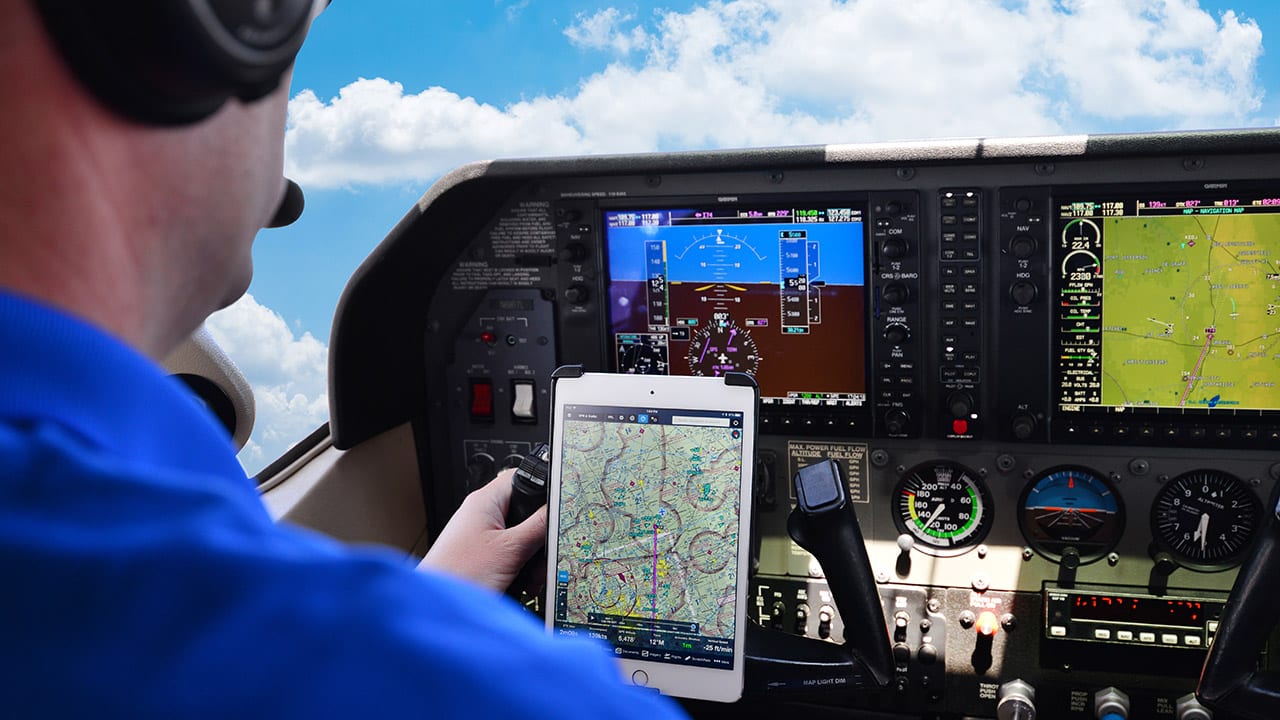 They say automation breeds bad habits, but I think automation training is where the blame lies.
Here’s one beef: What should you do when the autopilot fails to capture the glideslope or turns right when you expected left?
You should disengage the autopilot and hand-fly, right?
Wrong. Wrong. Wrong.
Think about this objectively for a moment. Right at a critical moment in the approach, you’ve been hit with a surprise, so you double your workload by throwing out one of your best IFR tools. You do it right when a precise flying action is required. And you’re distracted because part of your attention is off thinking, “Why did the autopilot do that?”
Our Faith in NEXRAD
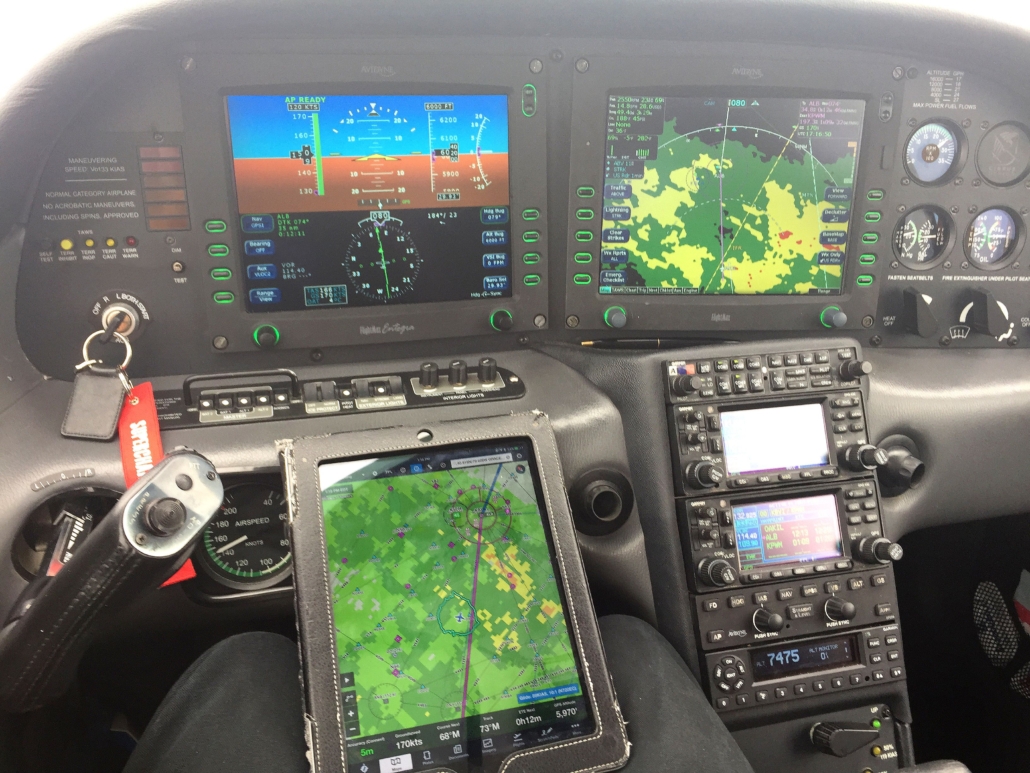 In my younger days, my concept of weather data in flight was watching the clouds get darker as I trundled along the VOR radial, and wondering how rough the next 30 minutes might get. Now, I feel naked without in-cockpit weather, and will ask for deviations around denser precip just to keep from spilling my coffee.
But such confidence can get a harsh reality check now and then. Let me share a story of a flight that could be titled, “A Man with Two Watches.”
The route was direct Albany VOR (ALB), when two hours of hand-flying through IMC looked like it would end. (Yeah, that’s a photo in a Cirrus with the autopilot off. It’s not digitally altered. We all need the practice to stay sharp.) The iPad in my lap displayed ADS-B weather with stronger returns right of my course. The smoothest ride might have been to head a bit left (north), before crossing over ALB as planned.
Making Avionics Sing
 I’m an unabashed geek when it comes to avionics. My flight instruction career has lived in parallel to one in technical education and writing. It also started less than a year after Garmin introduced the original GNS 430, so maybe it was destiny that my niche would be avionics training and IFR training.
That said, I despise pushing pixels around just for the wow factor. I want every bit of tech to do something for me. The effort needs to have some payoff in speed, ease, or safety.
Obvious payoffs are simple, but subtle ones can be equally important. How you use your cockpit technology affects how you interact with the flight. It reinforces—or erodes—habits that promote safety. Put more grandly, the way you use your cockpit tech changes the way you think in flight.
Practical IFR: Does Your Approach Use the Wrong Minimums?
 It’s a dark and stormy night. You’re instrument current and proficient. Your bird is well equipped. But you’re concerned because the reported ceilings have been going up and down on both sides of the published minimums.
To which I say, “Who cares?”
Seeing Is What Matters
Put yourself on the approach and descending. You will either break out to see something, or you won’t. It’s binary; one or the other. If you see nothing before the prescribed moment arrives, you commence the missed approach. Simple.
If you see something … well, now you must judge.
Practical IFR: “Cleared to Intercept?” A Common IFR Dilemma
 Fly IFR and you’ll run into this situation soon enough: You’re on a base-leg vector to the localizer or inbound course. A kickin’ tailwind has you screaming over the ground. The needle comes alive, and you know you need to start the turn now or you’ll overshoot. However, ATC seems to have forgotten you. Do you start the turn as you try to verify you’re cleared to intercept the inbound course? Or do you hold your heading while clamoring for the clearance, knowing you’ll blow through and need a new heading to re-intercept?
This is one of those places where there’s a right and wrong answer per the regs, but it’s not so cut-and-dry in the real world. By the book it’s simple: You have not been cleared for the approach, so turning off your heading is a violation of 14 CFR 91.123 unless you have good reason to suspect communications failure or it’s an emergency. By the book, you’re going to blow through that inbound course.
Practical IFR: Practice Approaches
It’s easy to get in a rut practicing approaches around your home ‘drome. You know the airports; you know the frequencies; you fly with the same buddy before stopping at the same airport diner for the same pastrami on rye.
Or, maybe you don’t even practice approaches enough to have a “same.” Don’t feel bad; you’re not alone.
For many pilots, serious IFR happens more in practice than travel. So, amp up your practice—and make it more appealing to do on a regular basis. (Set aside the simulator discussion for now. Let’s just talk about real-world aircraft.)
