
ODP Versus VCOA (Visual Climb Over Airport)
Want to see some mumbling and hand waving? Ask a dozen instrument-rated pilots to explain “… for climb in visual conditions …” in the textual departure procedures for an airport.
It’s not their fault. Departures, in general, are the overlooked middle child of instrument procedures, which makes the Visual Climb Over Airport (VCOA) akin to the weird uncle who shows up at Thanksgiving and gets politely ignored.
The key is that a VCOA is an alternative to the obstacle departure procedure (ODP). You do one or the other, but not both. You must also inform ATC you’re planning on flying the VCOA when you request your clearance. Step one on that planning process is determining if obstacles are even an issue.

A Diversity of Departures
Every airport that has a published instrument approach has also been surveyed for departures. It’s assumed that an aircraft will cross the departure end of the runway (DER) at 35 feet AGL, and climb to 400 feet AGL on runway heading, with a climb gradient of 200 feet per NM.
This creates a point in space. The survey then asks, if the aircraft continues to climb at 200 feet/NM, could it turn in any direction on course and maintain required obstacle clearance? For airports in the middle of Nebraska and other level places, the answer is usually, “yes.” This means the runway qualifes for a “diverse vector area,” and no departure procedure is published. This older term for this is a “diverse departure,” and that makes more sense from a pilot’s perspective. You can depart in any of a diversity of directions, so long as you keep climbing at least 200 feet/NM.
The survey is done for every potential departure runway, and if all qualify for a diverse departure, the airport might not even appear in the departures section of the terminal procedures.
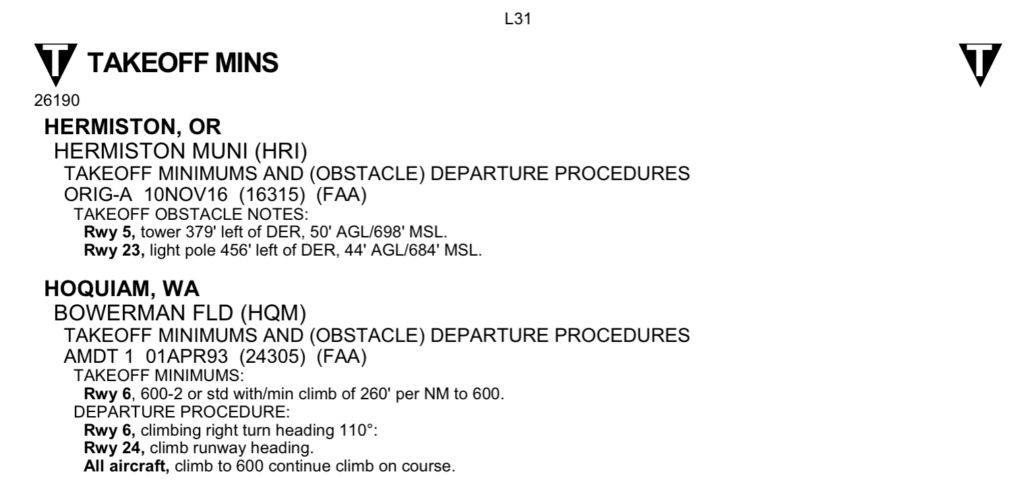
If a departure runway fails this test, a remedy is published. This simplest fix restricts how early the aircraft can turn, such as the procedure for Runways 6 and 24 at Hoquium, Washington (KHQM). Both runways require climbing to 600 feet before you can diversely fly in any direction you want. From Runway 24, that’s climb on runway heading to 600 feet. From Runway 6, it’s a climbing right turn to 600 feet.
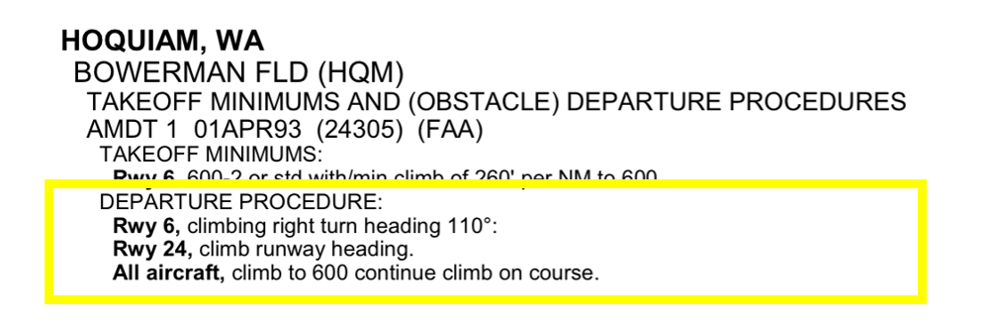 Wait: Does that mean you’re supposed to start a right turn as soon as you get airborne? No. It’s still assumed you don’t change from runway heading until 400 AGL, but then it’s a right turn to heading 110° for the next 200 feet—if you even get that big a heading change in only 200 feet. Regardless of the runway though, from 600 feet AGL and up, it’s a diverse departure.
That second part is key: Almost all ODPs get you to a point from which you can continue to climb at 200 feet/NM up to your assigned altitude.
Another remedy is defining a higher required climb gradient. Hoquium has this as well from Runway 6: You must do that climb to 400 and then continue climbing to 600 while turning right, all while climbing at least 260 feet/NM.
You can see why the defaults of runway heading to 400 feet and 200 feet/NM really matter. The standard stuff will not be repeated. You’re left to fill in the missing bits.
If a simple fix won’t do, a more complex departure procedure might be published. Sometimes this is a fully charted procedure, which is worthy of its own article. However, that departure is usually a textual procedure.
They can still be pretty complicated.
Take a look at McMinnville, Oregon (KMMV). You’ll see the takeoff mins specify some greater-than-standard climb gradients. Okay. If you’re flying a 152, you might need to run some numbers on hot day to make sure you can do that up to 1400 feet or so. (Kidding.)
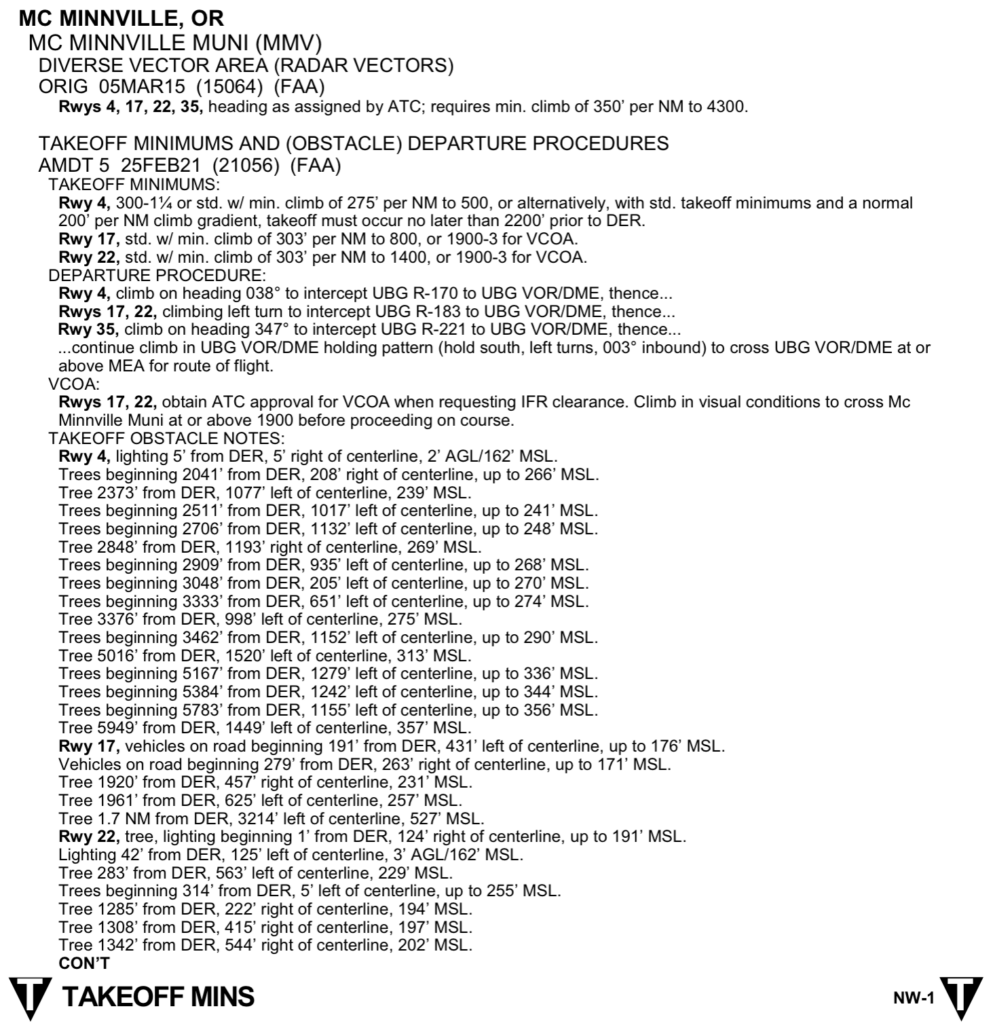
But then there’s the route you must fly. You might want to get out a pencil to draw that out. No, seriously. It’s great to annotate your Sectional Chart in your EFB to make sure you understand the climbs, turns, course, and holds before you can “cross the UBG VOR/DME at or above [the] MEA for route of flight.”
There must be a simpler way—and there is if the weather is good enough and you can depart Runways 17 or 22. Back in takeoff minimums section you’ll see “or 1900-3 for climb in visual conditions.”
The VCOA is listed for those two runways just below the departure procedure. It says, “cross the airport at or above 1900 feet before proceeding on course.” At what climb gradient? You guessed it: 200 feet/NM. Where the VCOA ends, the diverse departure begins. Or, put differently, the VCOA raises the floor of the diverse departure to a point you must reach visually before continuing in IMC. So, if you have at least 1900-foot ceilings and 3 SM visibility, you can spiral up instead of fly the ODP. Just make sure you get ATC approval, like it says in the text.
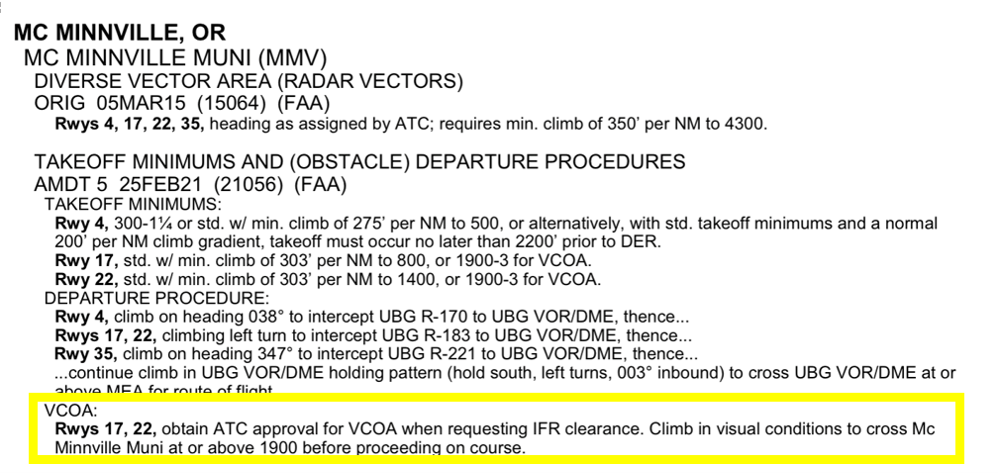
What about Runways 4 and 35? No VCOA is published. Under Part 91 you could depart that runway, climb in visual conditions to cross the airport above 1900 and then go. But there’s some reason the there’s no VCOA. So, I wouldn’t recommend it, but at least your estate can claim you didn’t break any rules.
Before we leave McMinnville, look up to where it says “Diverse Vector Area.” There’s a whole ‘nuther climb gradient here, and it’s a hefty 350 feet/NM. The key is the text “heading as assigned by ATC.” If you are giving a heading to fly off the airport in your clearance (which would be after reaching 400 AGL) this is the climb gradient you need. Can’t do that? You should decline that clearance and negotiate to fly the ODP or VCOA instead.
Now slide over to Cody, Wyoming (KCOD) by Yellowstone (I hear there are some hills around there), and you’ll see the less common “routed VCOA,” meaning it has a departure you follow even after you enter the clouds. Spiral up over the airport to 9400 feet MSL (in visual condition) and then proceed via the COD VOR 189 radial inbound to cross the COD VOR at or above the MEA. Note that the second part on R-189 can be IMC. And, you guessed it, climbing 200 feet/NM.
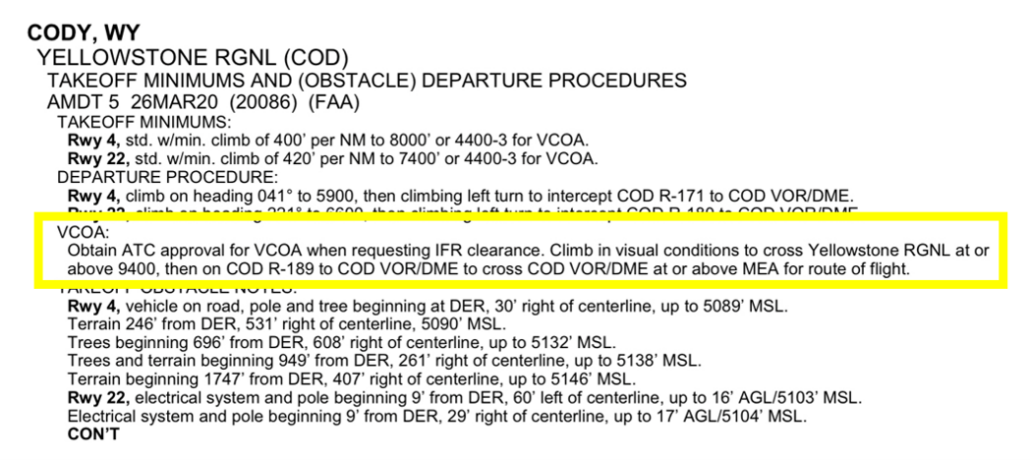
KCOD also shows how a VOCA can really pay off. The ODP climb gradients are 400 or 420 feet/NM to altitudes of 8000 feet MSL or 7400 feet MSL, respectively. This requires an 800 foot-per-minute climb, if you have a 120-knot groundspeed. Many light aircraft can’t maintain that climb at 8000 feet MSL. The VCOA has no required climb gradient until you reach routed, second part. Take as long as you need to climb. Enjoy the view — and use it to stay off the rocks.
Don’t let the VCOA ceiling of 4400 feet and the spiraling up to 9400 feet phase you. KCOD’s airport elevation is 5102 feet. But, you say, that means there’s a 100-foot of VCOA that might be IMC. Yeah, that happens on some of these VCOAs. Just stay generally over the airport. There isn’t much to hit there.
Quick Poll

Estimating Required Climb Rates
We don’t have climb gradient instruments in our aircraft. Instead, we have climb rate instruments.
Luckily, some EFBs have fields for climb gradient you can use to get a real-time read for how your climb is doing. If you’re doing departures in hilly areas, I recommend making this one of the fields on your map page. Put up and terrain and obstacle warnings too.
You can also do the math. It’s groundspeed/60 multiplied by the climb gradient. For a groundspeed of 90 knots, the standard climb gradient of 200 feet/NM converts to 300 feet/min (90/60 * 200).
If you know your climb rate for the standard gradient, you can do a quick estimate for non-standard ones. If the required gradient is 375 feet/NM, round up to 400 feet/NM, which is twice standard. Assume you’ll need 600 feet/min, if you expect 90 knots groundspeed.
Just remember that it’s groundspeed, not airspeed that matters. You must factor winds into your departure planning. It’s also average climb rate that matters. If the departure requires 600 fpm while you climb and you see 700 fpm initially that drops to 590 fpm for the last 1000 feet.
Not that you could do much about it at that point anyway.

For 19 years, Jeff ran many noteworthy aviation media projects with his own firm, Van West Communications, including magazines, books, videos and live seminars. Jeff previously served as editor-in-chief of IFR Magazine and co-editor of Aviation Consumer, and his work appears in AOPA Pilot, Flight Training Magazine, Plane and Pilot, and AVweb. He’s an experienced CFII/MEI with ratings for single- and multi-engine airplanes, seaplanes, and gliders. Jeff was the creator of the first pilot transition program for new Cirrus aircraft.
- Practical IFR: The Extra Step-down - August 18, 2026
- What’s Wrong? Flying the RNAV 24 at Toledo in a Bonanza - August 7, 2026
- ODP Versus VCOA (Visual Climb Over Airport) - July 15, 2026

Jeff, I’m not sure if there is any defined radius for a VCOA but I believe they are only allowed if obstacles are at least 3SM from the departure end of the runway (see 65).
For the KMMV departure, looking at the sectional, terrain looks pretty flat off of both 4 and 35, especially compared to the hills off 17 and 22. Perhaps that is the reasoning behind no VCOA for 4 or 35? Nothing really prevents you from climbing at standard rate as long as you are airborne by 2200 feet before the end of 4.