

The Art of Briefing the Approach
|
Getting your Trinity Audio player ready...
|
Editor’s Note: Welcoming Elaine Kauh to IFR Focus
We’re excited to welcome Elaine Kauh as a regular contributor to IFR Focus. Elaine brings a rare combination of instructional depth, real-world flying experience, and writing talent to our community of instrument pilots.
A professional pilot, Master Instructor, and FAA Safety Team Lead Representative, Elaine has spent years helping pilots sharpen their skills in the IFR system—with a particular focus on emergency procedures and advanced avionics. She teaches in a variety of aircraft, from the Cirrus SR22 to classic taildraggers, and brings that same hands-on experience to her writing and speaking.
You may recognize Elaine from her past contributions to IFR Magazine, or from her expert guidance as part of PilotWorkshops’ IFR Mastery series. She’s also a familiar face at regional safety seminars and appeared on Sporty’s Pilot’s Discretion podcast, where she shared valuable lessons on both instrument flying and taildragger instruction.
With a background in journalism and a passion for thoughtful instruction, Elaine has a unique ability to make complex IFR topics practical and approachable. We’re proud to feature her work at IFR Focus, and we look forward to the insights she’ll share with our readers in the months ahead.
The Art of Briefing the Approach
by Elaine Kauh

There’s a lot to keep track of when nearing the initial approach fix or that last vector-to-final. Along with all those numbers for altitudes and courses to fly the procedure, you have things to do to the airplane—like adding flaps and adjusting power. It’s all part of what makes the approach a high-workload phase, so anything to help you get ready before it gets busy is a good idea. And that means being ready for anything. Enter the approach briefing.
Along with callouts for some phases of flight (another great discussion), this is another standardization aid that we can borrow from professional flight crews. If you learned to do this during your instrument training, that’s great. Many of us did not, and verbally briefing elements of the approach isn’t a hard requirement for the rating. I learned the concept from an airline pilot while providing an IPC in a flight school rental. He took that practice into his single-pilot piston flying, and I took it out into my own flying and instructing. This has become a bit more common as training toward careers has ramped up, but there are plenty of us who haven’t seen this practiced in recurrent training and everyday flying.
Why bother? Approach briefings embed key elements and other good-to-knows into your brain before it gets too busy to look stuff up. Monitoring those needles at the Final Approach Fix and heading down the glidepath is no time to be wondering, What’s the DA again? You could fly everything perfectly then neglect one item, like the runway length, or the circling MDA, or that NOTAM for the higher DA due to lighting outages. Briefings prevent such gaps. Here’s a template, which can go on a printed card or an EFB-loaded document.
The main elements:
-
Approach title and airport, like “RNAV 27, KBYW, Byway Field.” Seems obvious, but this is a confirmation that you’ve got the right stuff programmed in the navigator and pulled up the same one on the tablet. Errors can and do happen here.
-
Weather. Are the ceiling and visibility legal for the IAP, or matching your personal minimums? If so, continue. If not, time for that plan B (to be followed with a new briefing).
-
Expected approach fixes/waypoints, crossing/transition altitudes, the inbound course and FAF, then ending elements like lights, a visual checkpoint, or anything you will look for. Again, you’re confirming expectations and preventing errors like programming the wrong IAF or altitude.
-
Minimums. Which line is yours? You should already know the aircraft category and DA or MDA—just double-check.
-
Runway and landing. “Runway 27 is 5,500 feet. I’ll land with 20 degrees of flaps and correct for the left crosswind. Land by the second taxiway and turn right at the third. Land no later than the runway intersection halfway down.” Have that maximum distance or furthest stopping point briefed here. That’s in case of unknowingly flying too far down the runway, which—if left unbriefed—can have a bad outcome. If briefed, there’s no doubt whether it’s safe to continue.
-
Missed approach. For example: “Disconnect. Full power. Pitch for 90. Flaps to 20. Positive rate, gear up. Flaps up. Climb to 1,500, then climbing left turn to 3,000 to MISSD and hold.” Remember that the “missed” is two operations in one: the go-around, which concerns the aircraft, and the missed approach, which is the procedure that governs the flight path. Going missed is also high-workload. Add a startle—like overshooting your landing spot or a vehicle entering the runway—and your brain will depend on deploying those next steps as briefed.
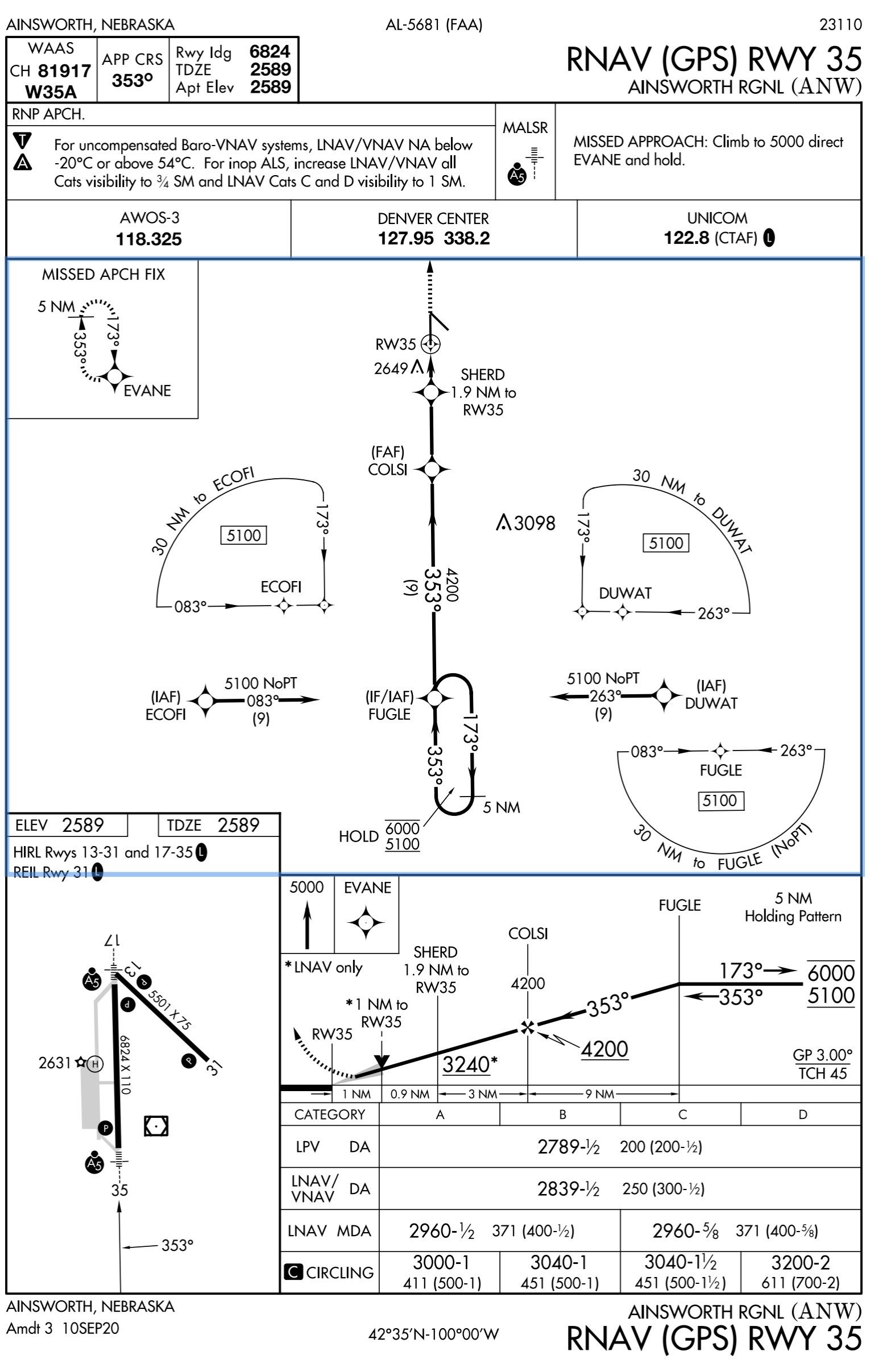 Try It Out: Let’s fly to Ainsworth Regional in Nebraska and do an approach briefing. You’re in a Piper Arrow arriving from the northeast, and the region’s drying out after a cold front passed, leaving low ceilings and a northwest wind in its wake. After copying the AWOS and relaying intentions to Center, the briefing is the next item on your descent or pre-approach checklist:
-
“Expecting the RNAV 35, ANW, Ainsworth. 31 is closed. Weather is 300–3, winds 300 at 15 knots.” (Notice I abridged the wording to be brief—yes, pun intended.)
-
“I am cleared direct to DUWAT initial fix and 5,100. Awaiting approach clearance. DUWAT, right turn at FUGLE. Inbound course 353. 4,200 feet to COLSI, final fix and glidepath intercept. One mile from COLSI, 10 degrees flaps, 100 MPH. Category B for winds. Fly to LPV minimums, 2,789–½. VDP one mile from 35.”
-
“Runway is 6,824 feet, medium approach lights with RAIL, PAPI on the left. Left crosswind. If I see the runway before minimums, go to second flaps. Final speed 95.”
-
“Missed: TOGA, power, pitch for 85; positive rate, gear up. At 95, flaps up. Climb runway heading to 5,000 direct EVANE and hold. Parallel entry, right turns.”
The most-asked question I get when discussing the best ways to use briefings: “That’s a lot to say—shouldn’t I be flying the plane?” Sure, and the briefing need not be in one chunk. This one takes about 60 seconds. You can customize it to fit your flying minimums, your aircraft, and the conditions of the day. Keys to success include covering each step when it fits best and committing to memory what you can (results may vary). Presumably, you reviewed the weather, desired approach, landing considerations, and NOTAMs before the flight, so it can be a quick review on descent. I use the pencil tool on my EFB to mark changes or reminders right there on the charts. Once you’ve confirmed these, you can start in on the IAP details—a lot of numbers that are more easily forgotten if you haven’t looked at them for a while. You can easily brief those several miles out from an approach clearance, which is a good “deadline” to call the briefing complete and continue with your checklists.
If expecting a visual approach, briefings are just as useful because you still want a game plan for this highly variable operation. Say Ainsworth is now 5,000 and 5 and you’re cleared for the visual. Brief the plan and perhaps program into your GPS the descent to traffic pattern altitude by one mile from the pattern entry (here, 3,500 feet). Landing checklist, fly overhead, enter left downwind for 35, recite the go-around.
There are a lot of options for easing into this practice. Start with briefing some essentials next time you’re out doing practice approaches flying VFR: Read the fixes and what to push, dial, and target for course and altitudes as you near each one—including the missed approach. Just by adding the item Approach Briefing to your descent or approach checklists, you can make that busy time smoother, easier, and with set boundaries. That means safer, which always makes flying approaches more enjoyable.

- Into the Clouds: Hazards in Your Head - July 7, 2026
- A New Take on Alternates - May 12, 2026
- Airspace: Who Cares? - March 10, 2026

Why is Ms. Kauh briefing a VDP on an LPV (glideslope vertical guidance to DA) approach? The starred note even says, “LNAV only” (non-precision level-off no lower than MDA until VDA or MAP).
If she is allowing for the possibility that while in progress the approach degrades to LNAV due to avionics self-monitoring position error, I believe that requires a more extensive re-focused brief, or more likely executing the missed and setting up for return to a non-precision approach with different technique and expectations.
The frequent recurring teaching blogs on LPV/LNAV/DH/DA/VDP… suggest there is already sufficient confusion about various RNAV/GPS approaches. Mixing elements from each into one approach brief seems distracting and potentially dangerous.
Despite the fact that the VDP is listed as approach specific, it really is just an advisory waypoint to let the pilot know that a nice 3 degree descent will lead you to salvation. Add a stipple and you are really in good shape (no obstacles, at least the last time it was surveyed, caveat emptor).
In this case, with the 300-3, I would expect to go visual BEFORE the DA (about a 100-foot delta when I break out and see the runway given the visibility and where I should be on the approach). Remember, you don’t have to, and hopefully don’t always, fly to the DA on a precision approach. And the VDP gives me a bit more SA when I decide to go visual to land. Btw, nowhere did she say you had to brief all of this information anyway; in fact, I would argue expectation bias is your worse enemy in a brief and there is an implicit balancing act here. A very good topic for an article me thinks!
Excellent procedure to brief especially when single pilot IFR in high workload airspace.
Eliane, so good to see you here, I was an IFR subscriber for many years and used to enjoy your in-depth articles. I look forward to reading more of your excellent contributions.
ASEL, Instrument