
Departures Get a New Look
|
Getting your Trinity Audio player ready...
|
Obstacle departure notes have gotten a long-overdue update. The new format gives us some useful options, along with a new vocabulary to sort out.
Let’s say you’re getting ready to depart Sallisaw Municipal, Oklahoma (KJSV), on an IFR flight. You pull up the departure procedure to check the takeoff minimums and climb requirements, but there’s something about it that looks different from what you’re accustomed to seeing. Along with the familiar ceiling, visibility, and climb-gradient alternatives, there’s an option to cross the departure end of runway (DER) at a specified height that “clears takeoff minimums obstacles.” That sounds useful, although it might leave you wondering which obstacles wouldn’t qualify as takeoff minimums obstacles when you’re taking off.
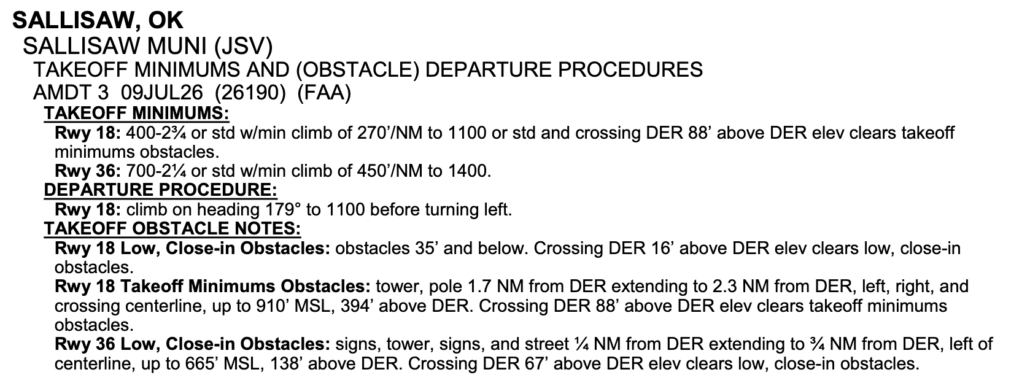
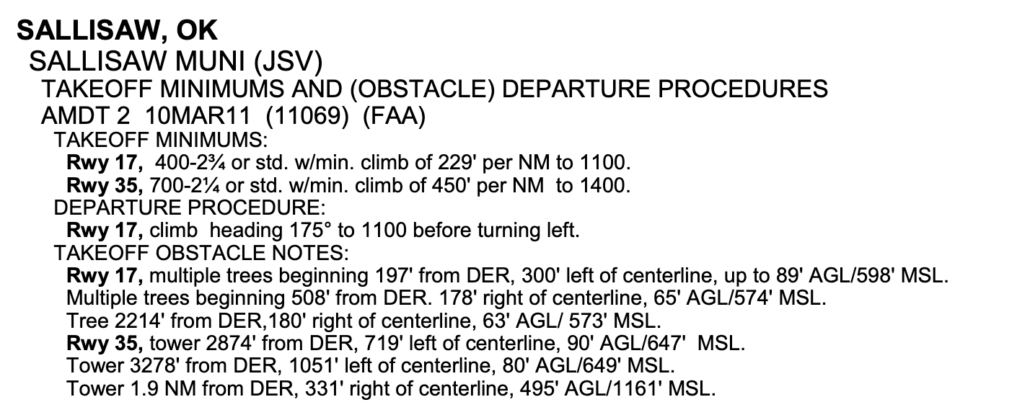
Compare that with the older Sallisaw entry and the changes become easier to spot. In addition to the bold and underlined headings, the individual descriptions of trees and towers have been replaced by grouped summaries, now divided into “Takeoff Minimums Obstacles” and “Low, Close-in Obstacles,” with separate DER crossing-height statements. The FAA has given us another way to plan the departure, but making use of it requires first understanding what those labels mean. Before choosing an option, we need to know which obstacles it takes care of and what we’re expected to do about the others.
Sorting Out the Obstacles
For Runway 18, the updated takeoff-minimums obstacle note describes a tower and pole between 1.7 and 2.3 NM from the DER, “left, right, and crossing centerline,” reaching 910 feet MSL, or 394 feet above DER. (“Crossing” meaning within 100 feet of the extended runway centerline, per AIM 5-2-9e4(c)(5).) Read that as a description of the group’s general extent, since it doesn’t tell you which object is where. Notice that there’s also a change in the height reference. The older entry uses AGL height, measured from the ground beneath the obstacle, and the updated notes reference height above DER instead. This compares the obstacle’s elevation with the runway end, which is a more useful frame of reference considering that’s what your climb is based on.
The older notes called out individual obstacles and clusters of trees with specific distances and lateral offsets. That’s precise information, although turning it into something useful while sitting in the cockpit takes a bit of imagination. The new description groups those objects and generalizes their locations, so you can’t pick out a particular pole from its published offset anymore. What you do get is the general direction, distance, and height of the obstacles you need to be aware of. That’s arguably an improvement if you’re trying to understand the departure environment, even if you may still need a better picture when the plan involves visually avoiding something.
Reducing that clutter was part of the reason for the change. A lengthy list of low-close-in obstacles could make it difficult to pick out which obstacles drive the takeoff minimums. The revised notes separate those categories, as explained in AIM 5-2-9e4. That distinction gives the headings a job beyond organizing the page: they connect the obstacles to the departure choices. To understand what a particular choice clears, we first need to understand why an obstacle belongs in one list rather than the other.
Reading the Fine Print
For Runway 18, Sallisaw gives us three takeoff alternatives: a 400-foot ceiling and 2¾ miles visibility, standard minimums with a climb of at least 270 feet per NM to 1100 feet MSL, or standard minimums while crossing the DER at least 88 feet above its elevation. Each provides a way to adequately clear the takeoff-minimums obstacles. The higher ceiling and visibility allow you to see and avoid them; the climb-gradient option provides a way over them. The crossing-height option gives you a head start on the climb by requiring you to reach a specified height before leaving the runway behind.
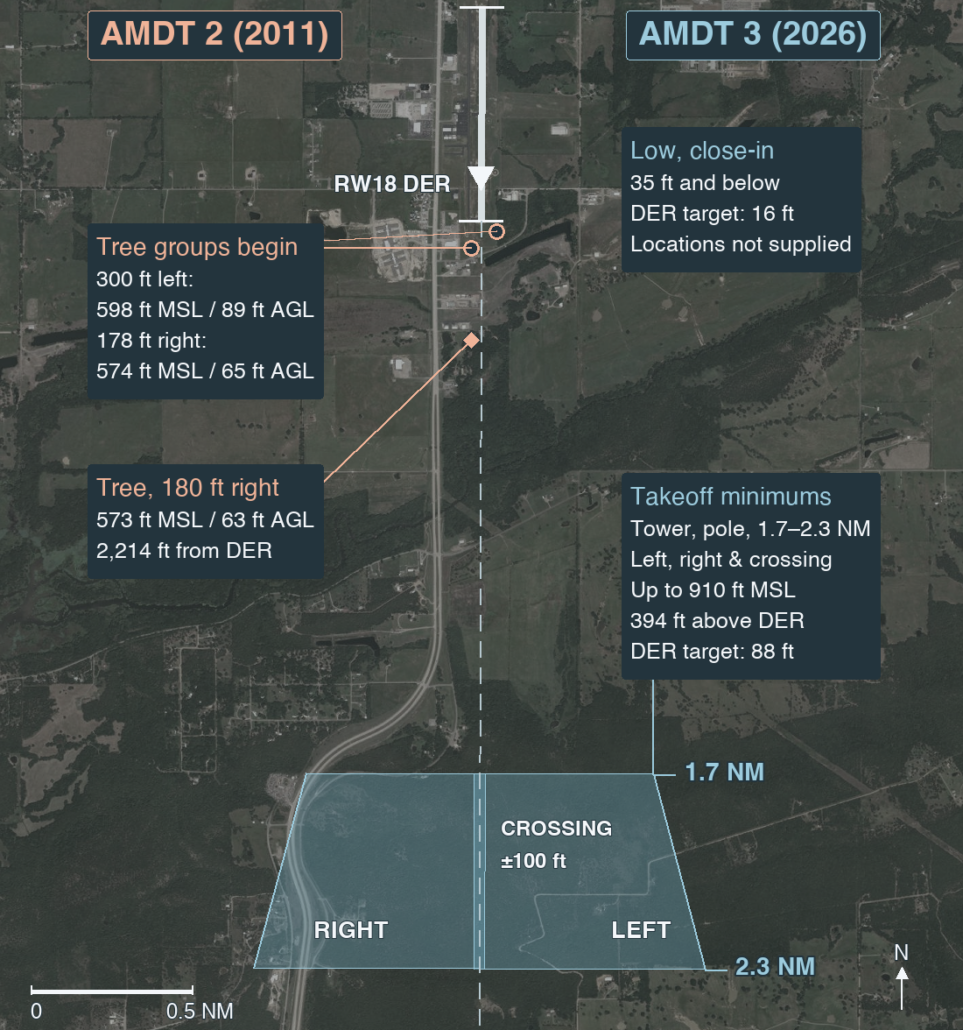
An obstacle close to the runway presents a somewhat different problem. Even a relatively low obstacle can require a steep climb if there’s little distance available to gain the height. AIM 5-2-9e4 distinguishes low-close-in obstacles as those requiring a higher-than-standard gradient to an altitude of 200 feet or less above DER elevation. Historically, these were mixed into the obstacle notes rather than used to impose a steep gradient for that short climb. Pilots still had to clear them through performance or visual avoidance, which gets awkward when visibility is poor.
For visual avoidance, AIM 5-2-9f2(a) even says that, depending on obstacle position, a ceiling of at least 300 feet and visibility of one mile may be necessary to see and avoid them. Those aren’t additional published takeoff minimums; they’re practical guidance for deciding whether visual avoidance will work. The new low-close-in crossing-height statement supplies a concrete performance target for a clearance problem that was there all along.
Back at Runway 18, the 88-foot statement addresses the takeoff-minimums obstacles, while the 16-foot statement addresses the low-close-in obstacles. If you’re using the 88-foot option and continuing the climb at least 200 feet per NM, you’ve also exceeded the close-in target here. The 16-foot figure doesn’t reduce the normal assumption that you’ll cross the DER at least 35 feet above its elevation. Turn the departure around to Runway 36 and the distinction becomes more consequential: its 67-foot crossing-height statement clears the low-close-in obstacles, but the takeoff minimums still call for 700-2¼ or standard with 450 feet per NM to 1400 feet MSL. You can’t substitute 67 feet at the runway end for that climb requirement simply because the note says it clears obstacles. Which obstacles it clears is the part that matters.
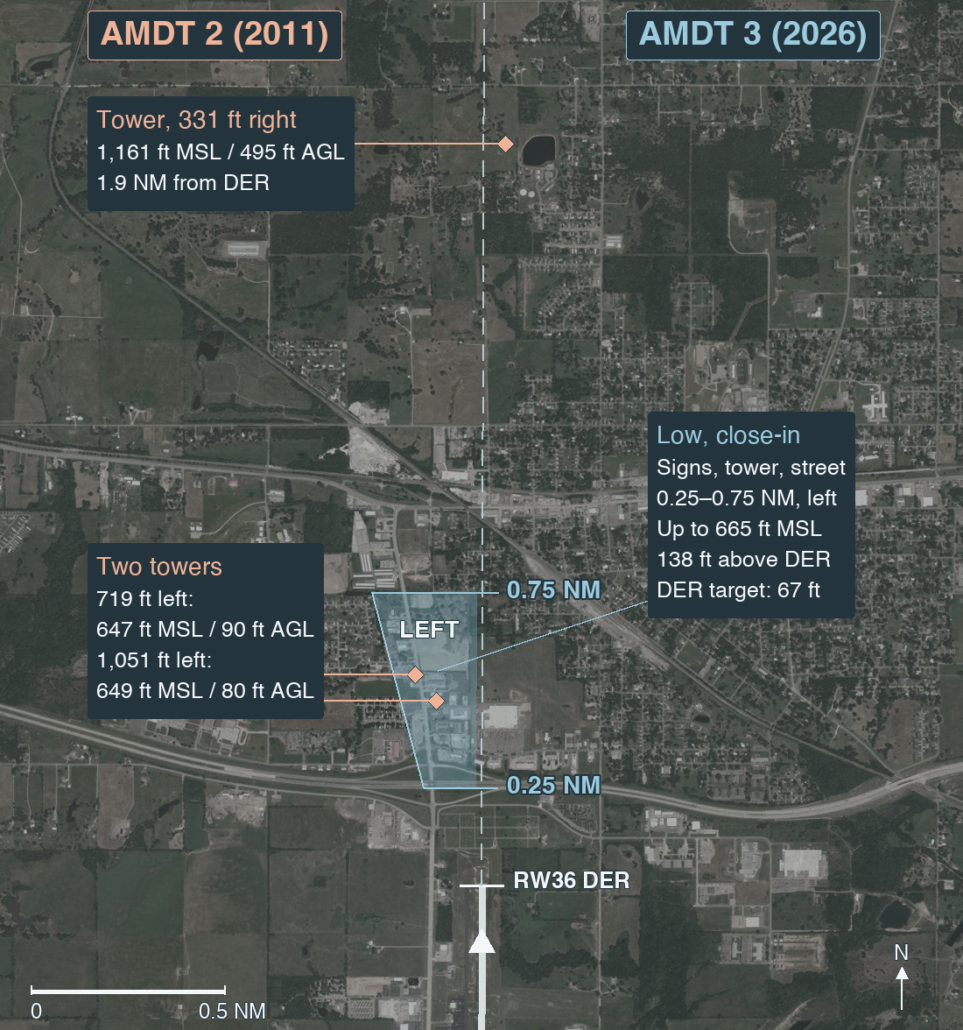
Know What the Crossing Height Clears
The crossing height only addresses the obstacle category identified in the departure notes. It doesn’t automatically satisfy other takeoff minimums or climb-gradient requirements.
Putting It Into Practice
Of course, having 88 feet printed on the chart doesn’t tell us whether the airplane can get there before the runway ends. Your POH may give you a takeoff distance over the proverbial 50-foot obstacle, but that alone doesn’t establish whether you could reach 88 feet by the DER. The climb chart may help, although its figures may assume a different airspeed and flap setting from the takeoff data. Connecting the two requires accounting for the transition, and your POH may not provide enough information to do that. The FAA has supplied a useful target, provided you can establish that it works for your airplane.
Verify Your Aircraft’s Performance
A published DER crossing height is a target, not proof that your airplane can achieve it. Use the available performance data to establish that you can meet the requirement before choosing that departure option.
If the performance charts leave you guessing, it doesn’t mean the airplane can’t get there, but it does leave you without enough information to base your departure on that option. You’ll need to evaluate the other published alternatives, and if none of them work for your performance and weather, you may need another runway or better conditions. If you can establish the crossing height, you’ll still need to continue climbing at least 200 feet per NM while following the departure routing.
However, don’t expect every departure to look like Sallisaw’s yet, since the old notes will remain until the departures are amended. You’ll need to digest both formats for a while. In the older entries, remember that the low-close-in obstacles are mixed into the list, and meeting the published climb gradient doesn’t necessarily clear them. You still need to determine whether your takeoff and climb performance will carry you above those obstacles or whether you’ll need to see and avoid them.
The revised format is intended to make the departure options easier to understand, although figuring out which ones allow you to actually depart still takes some effort. Departure planning means matching the airplane’s available performance to the crossing heights and climb gradients, while considering whether the weather allows you to see and avoid obstacles. The new notes help sort out those choices, but you still have to establish which combination works for your airplane and conditions.

- Departures Get a New Look - November 10, 2026
- Behind the MVA - October 27, 2026
- What Lies Beneath the MDA - June 25, 2026

Leave a Reply
Want to join the discussion?Feel free to contribute!